Role
Product Designer
Timeline
Feb 2025
Skills
UX Research
Interaction Design
Visual Design
Prototyping
Tools
Figma
Adobe Illustrator
Overview
QuickCare is a telehealth concept developed as part of the 2025 Rice Designathon, a 48-hour design challenge centered on staying human in the age of AI. The project explores how accessible telehealth services could support people living in rural areas of Sub-Saharan Africa with limited access to doctors and medication. The goal was to design a system that prioritizes accessibility, clarity, and real-world constraints such as limited resources and connectivity.
User Research
Research showed that access to healthcare in much of Sub-Saharan Africa is severely limited, with far fewer doctors per capita than recommended by the WHO. Existing telehealth solutions are sparse and often lack the scale, accessibility, or functionality seen in more developed regions. At the same time, emerging research around AI in telehealth highlighted opportunities to support diagnosis, triage, and care delivery in areas with limited medical infrastructure, informing the direction of the concept.
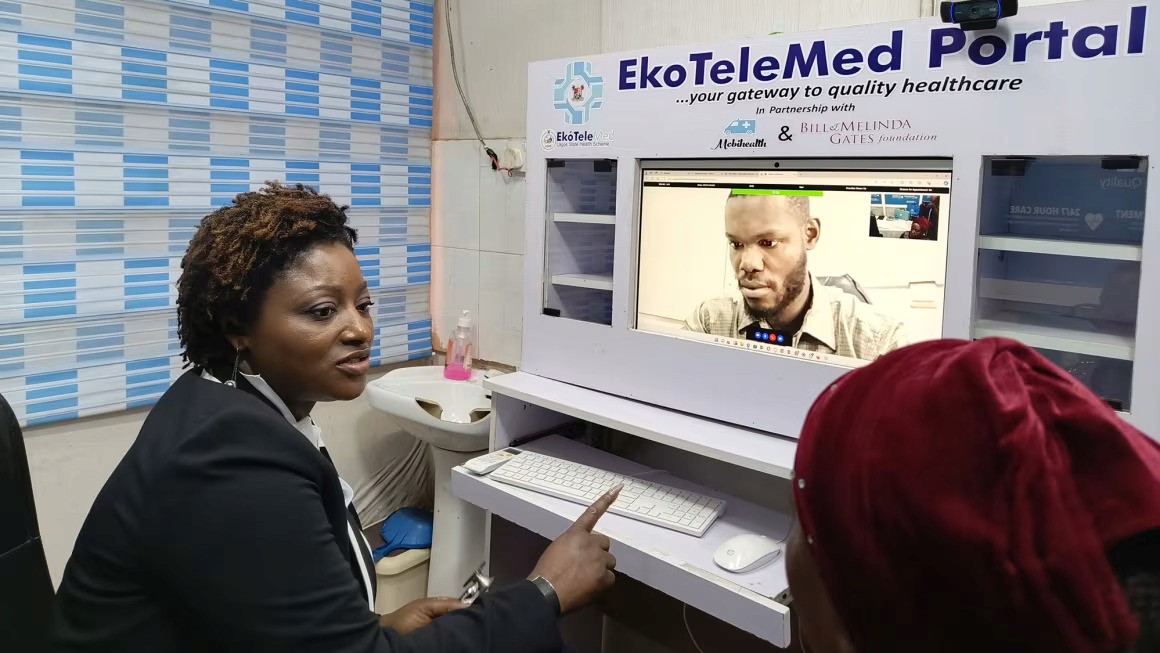
Dr Funmi Adewara, founder and CEO of telehealth company Mobihealth. Mobihealth International
Telehealth in Sub-Saharan Africa is already possible and actively emerging. Expanding connectivity through technologies like Starlink, along with existing initiatives such as RD4A, ZimSmart Villages, and VakaAfya, demonstrates that remote healthcare delivery can work even in underserved regions. While these solutions are still limited compared to telehealth systems in more developed countries, they show clear proof of feasibility and highlight opportunities for more accessible, scalable care.
Ideation
Ideation began with creating a user persona to ground the concept in real needs and constraints. That persona directly informed a short, feasible feature list that could realistically be designed within the 48-hour Designathon timeline. From there, I sketched a rough flow of how the core features would connect, helping visualize the experience before moving into higher-fidelity designs.
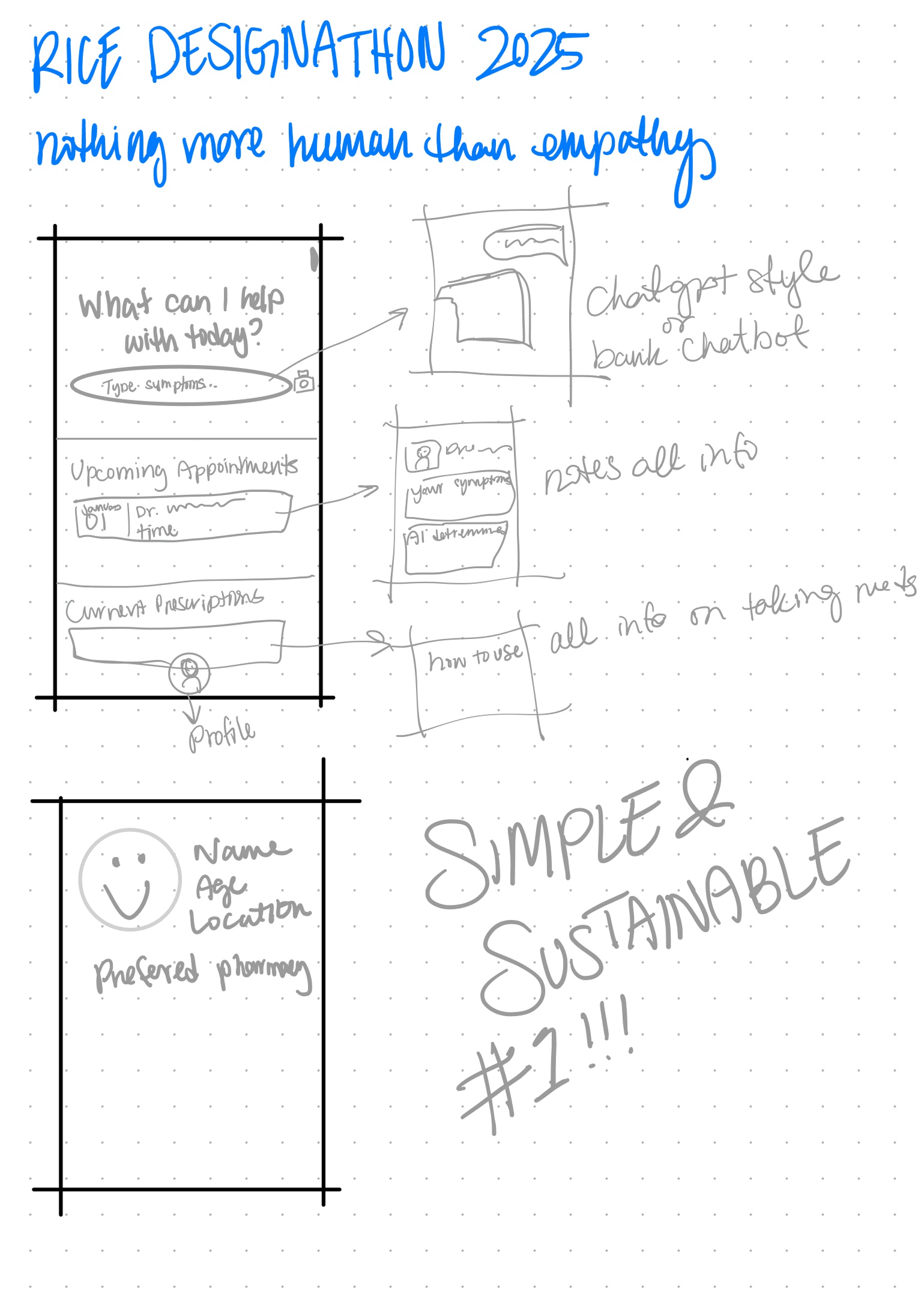
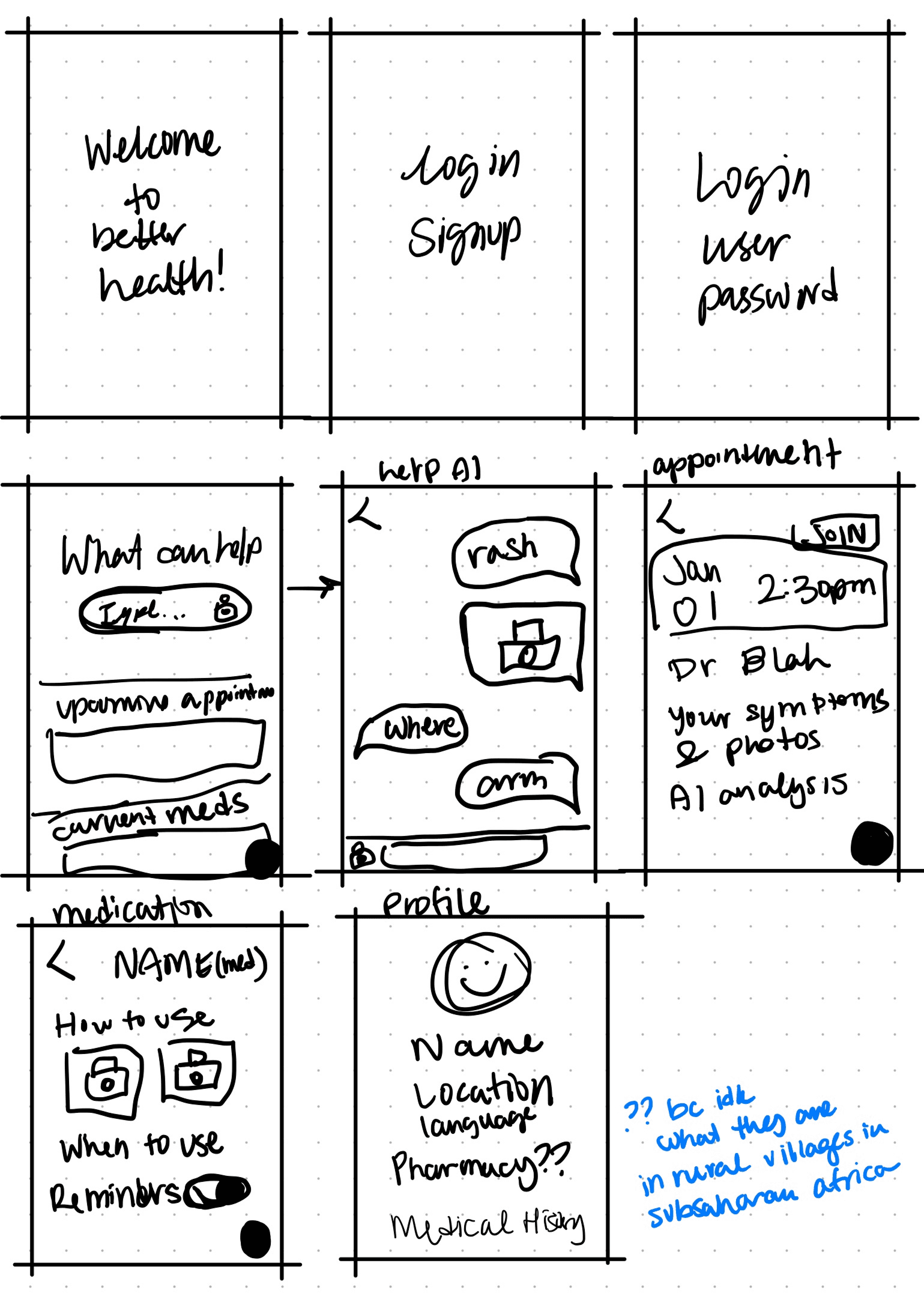
After sketching the initial flow, I narrowed the concept to what could realistically be designed within the Designathon timeline. I pivoted away from photo upload and the AI training pipeline, since those features required more technical detail than we could fully define at this stage. I also set aside the doctor-facing interface and focused entirely on the patient experience, prioritizing the core journey from symptom input to triage and next steps.
Color & Graphics
Sustainability influenced both the UI decisions and the visual palette for QuickCare. Research shows that blue-heavy displays can use up to 25% more power than green or red, so the palette avoids unnecessary color bloat and stays intentional. I chose green-forward accents because QuickCare is a health-focused experience, and green’s connotations of safety, wellness, and reassurance align more naturally with the product than red. Keeping the visual system minimal also improves clarity, which is especially important for users who may be new to telehealth, AI, or mobile technology, since the interface needs to feel immediately understandable without relying on prior experience.
Final Design
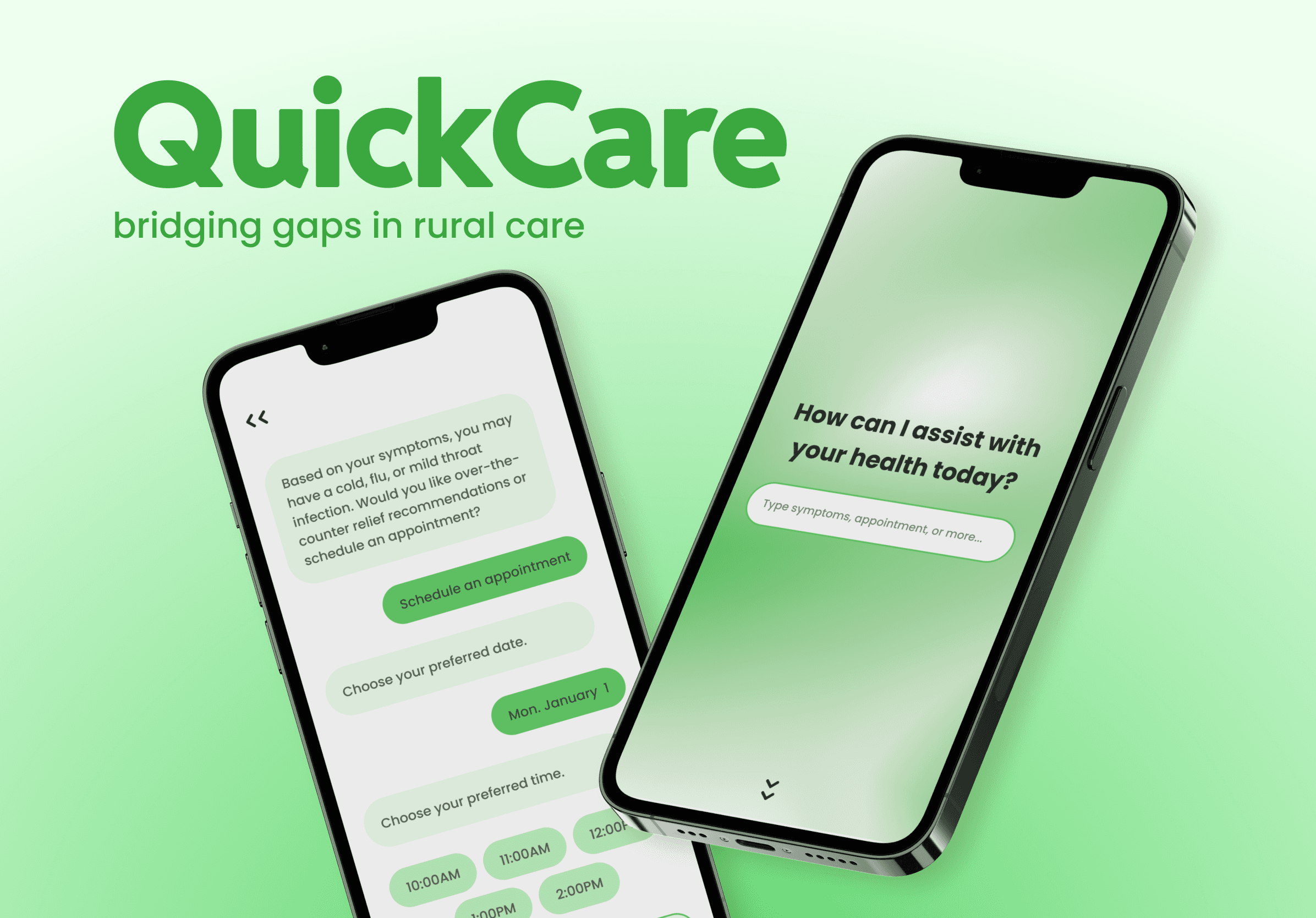
QuickCare’s home experience is intentionally minimal, using no bottom navigation and limiting buttons to reduce confusion and decision overload. Users scroll past the AI assistant to quickly access what matters most, including upcoming appointments, current medications, and their profile. The profile page lets patients store key health records so both the AI assistant and doctors can reference important context during care.
The chatbot interaction is designed to feel familiar and low-effort, working like a simple text conversation instead of a complex form. After gathering symptoms through clarifying questions, QuickCare offers two paths: over-the-counter medication or scheduling a telehealth appointment. In this flow, the user selects an OTC option and the medication is delivered from the nearest pharmacy to a pickup point set in their profile, then added to the homepage for easy access to directions and safety info.
QuickCare also supports escalation to human care through the same minimal, text-based chatbot flow. After symptom collection, the user chooses to schedule a doctor appointment and the chatbot guides them through selecting a date and time. Once scheduled, the appointment appears on the homepage along with an AI-generated overview the doctor can review beforehand, and after the visit the doctor’s analysis and prescription are saved to the user’s profile and medication list for continued guidance.
Reflection
QuickCare made it clear that designing for Sub-Saharan Africa cannot assume one uniform user group, since needs can vary widely by region, country, and access to resources. With more time, I would create a tutorial or guided onboarding experience to make the flow easier to understand, especially for users with lower digital literacy. I would also prioritize primary research with users in the target region to validate assumptions and better understand trust, behaviors, and real barriers to care. On the design side, I would refine the navigation and interaction prompts to make key features more discoverable and intuitive without relying on familiarity with other app patterns. Finally, I would explore how to communicate AI in a way that builds trust, ensuring it feels like a supportive tool rather than a replacement for human care.